The Words She Never Had: How One Hospital Laundry Worker's Late-Life Literacy Changed Safety Forever

Photo: Shixart1985, CC BY 2.0, via Wikimedia Commons
The Words She Never Had: How One Hospital Laundry Worker's Late-Life Literacy Changed Safety Forever
The hospital's infection control committee had been meeting quarterly for years. They reviewed protocols, updated checklists, consulted published literature. They were thorough, credentialed, and systematic. They were also missing something that had been right there in the basement the entire time.
Her name was Claudette Morrow. She had worked in the hospital's central laundry facility since 1971. She knew things nobody had thought to ask her.
 Photo: Claudette Morrow, via m.media-amazon.com
A Life Lived Around Words She Couldn't Read
Claudette grew up in rural Mississippi, the fourth of eight children. She attended school sporadically through sixth grade, pulled in and out by the rhythms of the farming calendar and a family that simply needed hands more than it needed readers. By the time she was twelve, the gap between her and her classmates felt too wide to cross. By fourteen, she had stopped trying.
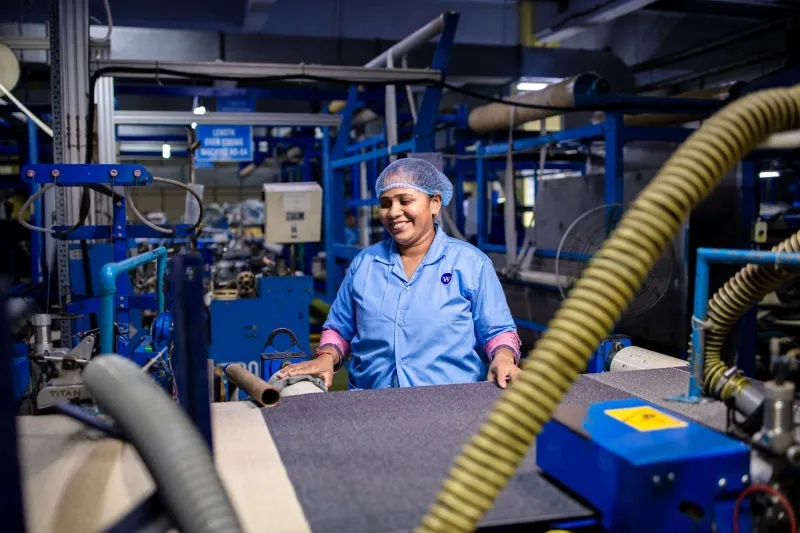
She moved north in her early twenties, following a cousin to a mid-sized city in Tennessee, and found work in the hospital laundry through a neighbor who knew the supervisor. The job required no reading. It required attention, physical endurance, an ability to categorize by touch and color, and a tolerance for heat that most new hires couldn't sustain past the first summer.
Claudette had all of those things in abundance.
She learned the job the way people learn things when there are no manuals available: by watching, asking, making mistakes, and paying close attention to the workers who'd been there longest. She developed an encyclopedic mental map of the facility — which carts came from which wards, what the stains meant, which items needed the hottest cycle, which needed the most careful handling. She knew which linens from the oncology floor required a different processing sequence than the general ward sheets. She knew which machines ran slightly cooler than their gauges indicated and compensated automatically.
None of this was written down anywhere. It lived entirely inside her head and the heads of the handful of long-tenured colleagues who'd learned alongside her.
What the Credentialed World Didn't Know to Ask
Hospital laundry facilities occupy a peculiar position in the healthcare ecosystem. They are simultaneously critical to infection control and almost entirely invisible to the clinical staff who depend on them. Doctors and nurses understand, in a general sense, that linens get cleaned. The specifics — the contamination categories, the temperature thresholds, the handling sequences that prevent cross-contamination — are assumed to be someone else's department.
In most hospitals, they are. The problem is that "someone else's department" often means a workforce that is predominantly low-wage, frequently undertrained, and rarely consulted by the infection control professionals making policy decisions one floor up.
The gap between what Claudette knew and what the hospital's written protocols reflected had been widening for years. She had watched new hires make errors that the official training materials didn't flag as errors, because whoever wrote those materials had never spent a shift in the basement. She had flagged concerns verbally to supervisors, who sometimes acted on them and sometimes didn't. But she had no way to document anything herself, no way to create a record that would outlast a single conversation.
"I knew what I knew," she said later, in an interview conducted after her retirement. "I just had no way to make it stay anywhere but in my own head."
The Literacy Program That Changed Everything
In 1994, the hospital partnered with a county adult literacy initiative to offer evening classes to employees. The program was voluntary, low-key, and initially attended mostly by younger workers. Claudette, then forty-four, almost didn't go.
She has described the decision as less dramatic than people expect. She wasn't inspired by a speech or a crisis. She was tired of asking her daughter to read her mail. That was it. That was the whole reason.
She enrolled in September. By January, she was reading at roughly a fourth-grade level. By the following fall, she was reading the hospital's own safety protocols for the first time — and finding them wanting.
"There were things in those documents that were just wrong," she said. "Not wrong like a typo. Wrong like whoever wrote them had never seen the inside of a laundry room."
Writing the Manual Nobody Else Could Have Written
Claudette didn't set out to write a safety document. She started, characteristically, with a practical problem: she wanted to leave notes for the night shift about specific situations that kept recurring. She began keeping a small notebook at her station, jotting observations in the halting but functional prose of someone still building their written vocabulary.
Her literacy program instructor, a woman named Sandra Okafor, recognized what was happening before Claudette did. The notebook wasn't just shift notes. It was a systematic, ground-level documentation of operational knowledge that existed nowhere else in the hospital's official record.
 Photo: Sandra Okafor, via www.mountsinai.org
Okafor connected Claudette with the hospital's quality improvement coordinator, a young administrator named Terence Webb who had the institutional sense to understand what he was looking at. Over the course of eight months, Webb conducted a series of structured interviews with Claudette, translating her observations into formal documentation language while preserving the specificity and granularity that made her knowledge valuable.
The resulting document — formally titled a Supplemental Operational Safety Reference, though Claudette always just called it "the notebook" — ran to forty-one pages. It covered contamination categorization protocols that the official manuals had oversimplified, machine-specific temperature compensation procedures, and a handling sequence for post-surgical linens that differed meaningfully from standard practice in ways that had real infection control implications.
The hospital's infection control committee reviewed it in 1996. They were, by multiple accounts, stunned.
"We had been writing protocols based on published literature and vendor specifications," one committee member told a healthcare administration journal several years later. "We had no idea that the people actually running the equipment had developed a parallel body of knowledge that was, in some respects, more accurate than what we were putting in the official manuals."
What Institutions Consistently Miss
Claudette's story is inspiring in the personal sense — the late-life literacy, the accumulated knowledge finally finding its outlet, the quiet persistence of a woman who showed up for work every day for over two decades with expertise that nobody thought to tap.
But it's also a structural story, and the structural part is less comfortable.
Hospitals are hierarchical institutions. The knowledge that counts — the knowledge that gets documented, cited, and built into policy — tends to flow from the top down. It comes from credentialed researchers, clinical specialists, and administrators with graduate degrees. The knowledge that accumulates at the ground level, in laundry rooms and supply closets and maintenance bays, is treated as operational detail rather than institutional intelligence.
Claudette's forty-one pages demonstrated, with uncomfortable clarity, that this division was costing something real. Not just efficiency — safety. The gap between the official protocols and actual practice in her facility had been quietly creating infection risk for years. It took a woman who learned to read at forty-four, and an administrator with the sense to listen to her, to close it.
After the document was adopted and adapted into revised hospital protocols, Claudette was promoted to a newly created training coordinator role. She spent her last seven years before retirement teaching new laundry staff — using, among other materials, the notebook she'd started as shift notes.
She retired in 2003. The protocols she helped develop were shared with several other hospitals in the regional network and remain, in revised form, part of their operational standards today.
Somewhere in a hospital basement right now, someone knows something important that nobody above them has thought to ask about. That's not an inspiring thought. It's an urgent one.