Hidden in Plain Sight: The Nanny Who Shot 100,000 Photos the World Never Saw
The Woman Who Documented Everything and Showed Nothing
On a cold Chicago morning in 2007, a young real estate developer named John Maloof walked into an auction house looking for old photographs to illustrate a book about his neighborhood's history. What he found instead was a storage locker's worth of undeveloped film, contact sheets, and mysterious negatives that had been abandoned when their owner couldn't pay the monthly fees.
 Photo: John Maloof, via static.wixstatic.com
Maloof bought the entire lot for $380, not knowing he'd just purchased one of the most significant photographic discoveries of the 21st century. Hidden in those dusty boxes was the life's work of Vivian Maier — a woman who had spent 40 years documenting American life with the eye of a master while working as a nanny, never showing her photographs to anyone.
 Photo: Vivian Maier, via cdn.pixabay.com
The Mysterious Miss Maier
Vivian Maier was the kind of person who slipped through the cracks of conventional biography. Born in 1926, possibly in New York, possibly in France — even basic facts about her life remain disputed — she spent most of her adult years caring for other people's children while pursuing her true passion in complete secrecy.
Families who employed Maier remembered her as an eccentric but devoted caregiver who always carried cameras around her neck. She spoke with a slight accent that no one could quite place, dressed like she'd stepped out of the 1940s regardless of what decade it actually was, and had an uncanny ability to connect with children while remaining somewhat mysterious to adults.
What they didn't know was that Maier was creating an extraordinary visual chronicle of American urban life, one frame at a time.
A Camera as Constant Companion
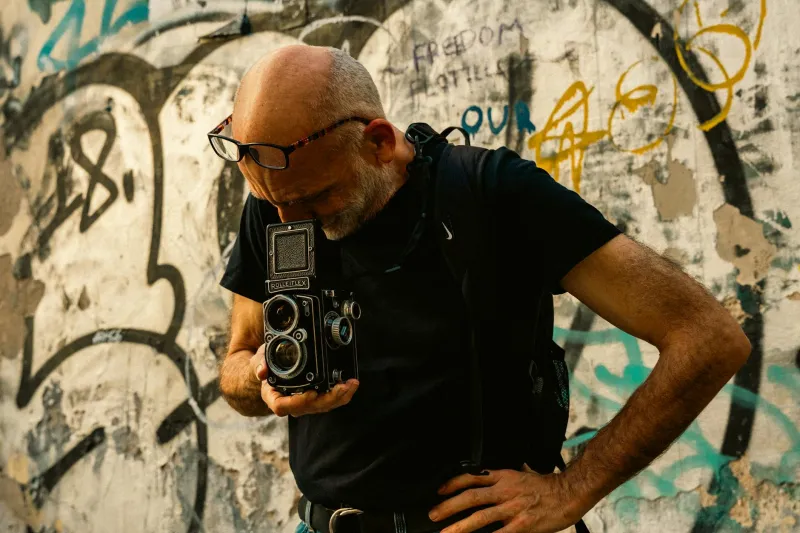
Maier's photographic journey began in the 1950s with a Rolleiflex camera — a professional-grade twin-lens reflex that she wore like armor against the world. Unlike most street photographers who tried to blend in, Maier was conspicuous with her equipment. But somehow, this visibility made her invisible. People saw the cameras and assumed she was just another tourist or hobbyist.
She developed an almost supernatural ability to capture unguarded moments. Her photographs reveal intimate glimpses of strangers: children playing in Chicago alleyways, elderly men reading newspapers on park benches, women shopping at markets, couples arguing on street corners. Every image pulses with life and reveals Maier's profound empathy for human experience.
What made her work extraordinary wasn't just technical skill — though her composition and timing were masterful — but her perspective as a perpetual outsider. Maier moved through the world as an observer, never quite belonging to any particular social class or community. This position gave her a unique vantage point for documenting the full spectrum of American life.
The Archive That Almost Disappeared
For decades, Maier processed her film in makeshift darkrooms — sometimes in the bathrooms of the families she worked for, sometimes in rented spaces around Chicago. She printed some photographs but left thousands of rolls undeveloped. She organized contact sheets meticulously, stored negatives carefully, but never exhibited her work or sought recognition.
By the 1990s, age and financial pressure forced Maier to make painful choices. She could no longer afford to maintain proper storage for her life's work, so she rented a storage unit and began filling it with boxes of negatives, prints, and undeveloped film. When she couldn't keep up with the monthly payments, the storage company prepared to auction the contents.
Maier died in 2009, just two years after Maloof's discovery, never knowing that her photographs were being celebrated by curators, critics, and collectors around the world. She passed away in obscurity, unaware that she was being hailed as one of the great street photographers of her generation.
The Accidental Revelation
Maloof's initial reaction to his auction purchase was disappointment. The photographs didn't fit his book project, and he almost discarded them. But something about the images nagged at him. The composition was too good, the moments too perfectly captured, the overall vision too cohesive to be the work of an amateur.
He began researching the name "V. Maier" that appeared on some of the materials. The trail led him to Vivian Maier, but by the time he tracked her down, she was in declining health and living in a nursing facility. She died before he could arrange a proper interview, taking most of her story with her.
What remained was the work itself — over 100,000 negatives that revealed an artist of extraordinary vision and technical skill. As Maloof began digitizing and sharing the images, the photography world took notice. Here was a complete unknown whose work rivaled that of celebrated masters like Walker Evans, Robert Frank, and Diane Arbus.
Recognition Without the Artist
The posthumous celebration of Maier's work has been both thrilling and troubling. Exhibitions of her photographs have drawn massive crowds at galleries around the world. Books of her work have become bestsellers. Documentary films have explored her mysterious life and extraordinary art.
But this recognition comes with uncomfortable questions about the nature of artistic discovery and ownership. Maier never consented to have her work displayed publicly. She spent her entire life keeping it private, and now it's being celebrated in ways she might have found horrifying.
Some critics argue that posthumous fame without the artist's consent feels exploitative. Others contend that work this significant belongs to the world, regardless of the artist's intentions. The debate reflects larger questions about privacy, artistic legacy, and who gets to decide what constitutes important art.
The Eye That Saw Everything
What makes Maier's photographs so compelling isn't just their technical excellence but their profound humanity. She documented wealthy families on Chicago's North Shore with the same attention and respect she gave to homeless individuals downtown. Her camera found beauty in everyday moments that most people would overlook: a child's expression of wonder, an elderly person's moment of solitude, the geometry of shadows on a city sidewalk.
Maier's work spans several decades and captures the evolution of American urban life from the 1950s through the 1990s. She documented the civil rights era, changing fashions, evolving architecture, and shifting social dynamics — all while remaining completely outside the established art world.
Her photographs reveal someone with an extraordinary visual intelligence who understood light, composition, and human psychology intuitively. She had no formal training but possessed the kind of artistic instinct that can't be taught.
The Lesson of Hidden Genius
Vivian Maier's story forces us to confront an unsettling possibility: How much extraordinary work exists in the world, created by people who never seek recognition or can't access traditional channels of artistic validation? How many brilliant photographers, writers, musicians, or inventors pursue their passions in complete isolation, leaving behind bodies of work that may never be discovered?
Maier chose invisibility, but her story suggests that countless others may be invisible by circumstance rather than choice. Her posthumous recognition reminds us that genius doesn't always announce itself or follow conventional paths to acknowledgment.
The Democracy of Vision
In the end, Maier's legacy isn't just her extraordinary photographs but what her story reveals about the democratic nature of artistic vision. She had no connections to the art world, no formal training, no institutional support. What she had was curiosity, persistence, and an uncompromising commitment to her vision.
Her work proves that the most important qualification for creating significant art isn't credentials or connections — it's the willingness to see the world with fresh eyes and the discipline to document that vision consistently over time.
Vivian Maier spent her life hidden in plain sight, caring for children while creating art that would outlast all of them. Her story reminds us that extraordinary work can emerge from the most ordinary circumstances, and that sometimes the most important artists are the ones we never see coming.