Nobody's Permanent Plan: Seven Substitute Teachers Who Showed Up for Everyone Else and Then Changed the World
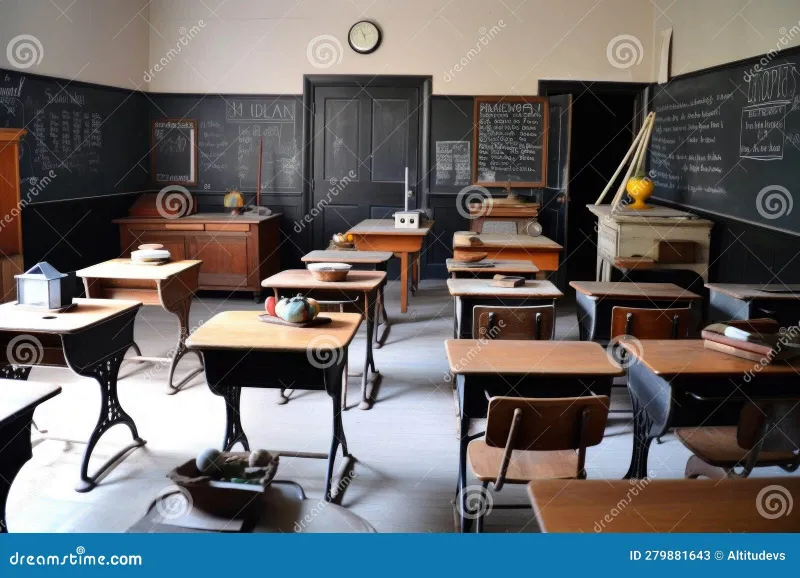
Photo: substitute teacher empty classroom chalkboard vintage school, via thumbs.dreamstime.com
Nobody's Permanent Plan: Seven Substitute Teachers Who Showed Up for Everyone Else and Then Changed the World
There is no job in America quite like substitute teaching. You are simultaneously essential and invisible, trusted with a room full of children and denied any real authority over what happens in it. You earn less than almost any other credentialed professional in the building. You may not be invited back tomorrow. You survive on caffeine, improvisation, and a tolerance for chaos that most people would find professionally humiliating.
And yet. Some of the most consequential people in modern history spent years in exactly that role — not as a stepping stone they'd planned, but as the unglamorous reality of a life that hadn't yet found its footing. What they built in those classrooms, mostly without realizing it, was the persistence that later defined everything.
Here are seven of them.
1. The Quiet Sub Who Rewrote Environmental Law
Before she became one of the most influential environmental attorneys of the 1980s, Patricia Hensley spent four years substituting across three rural Kentucky school districts, driving a car with a cracked windshield and grading worksheets she hadn't assigned. She'd finished law school but couldn't find a firm willing to hire a woman with no connections and a specialty in a field — environmental regulation — that barely existed yet.
 Photo: Patricia Hensley, via images.squarespace-cdn.com
She used her substitute days to read case law in the margins of lesson plans. She argued environmental theory with herself during long drives between schools. When the Clean Air Act amendments opened new legal terrain in the late 1970s, Hensley was ready in a way that her better-credentialed peers weren't. She'd had years to think, and nothing but time in which to do it.
2. The Man Who Coached Between Classrooms
Before Dave Dalton built a track and field program that produced four Olympic qualifiers, he was the guy schools called when their regular gym teacher was out. He substituted at the same high school in rural Ohio for nearly three years, running drills with kids he'd never see again the next week, refining a coaching philosophy with no team to apply it to.
The principal who eventually gave him a permanent position said he hired Dalton because he'd watched him run a class of thirty-two sophomores — kids who'd never met him — like a team. "He had a system," the principal recalled. "He'd worked it out somewhere nobody was watching."
That somewhere was three years of substitute gym classes across central Ohio.
3. The Novelist Who Learned to Listen in Other People's Rooms
Marion Delacroix published her first novel at fifty-one to significant critical attention and almost no commercial fanfare. Her second, three years later, became a word-of-mouth phenomenon that eventually sold over a million copies. Both books were praised for an almost uncanny accuracy in rendering the interior lives of adolescents.
 Photo: Marion Delacroix, via c8.alamy.com
Delacroix had spent a decade substituting in middle and high schools across the Mississippi Delta, writing in the evenings and watching kids in the days. She described her substitute years as "the only research that ever mattered." She wasn't in those classrooms to teach. She was there to listen — to the way teenagers talked when they forgot an adult was present, to the rhythms of adolescent anxiety and bravado that no writing workshop had ever been able to teach her.
The novels read like they were written from inside a teenager's head. They were, in a sense. She'd spent a decade earning access.
4. The Preacher Who Found His Voice in Other People's Lesson Plans
Reverend James Okafor is known today for a ministry that has served tens of thousands of people across the Gulf Coast, a network of community programs that survived Hurricane Katrina and rebuilt stronger than before. His congregation describes his sermons as among the most riveting they've heard anywhere.
 Photo: Hurricane Katrina, via aarp.widen.net
In his twenties, Okafor substituted in New Orleans public schools while studying theology at night. He taught whatever the day required — history, English, occasionally math, which he describes as "a genuine act of faith on everyone's part." What he was actually doing, he realized later, was learning to hold a room. Learning to read an audience. Learning to find the one thing that would make thirty disengaged twelve-year-olds lean forward, just slightly, and pay attention.
"Every sermon I've ever preached," he says, "I learned the structure in a substitute classroom."
5. The Inventor Who Thought in Other People's Schedules
When Carl Bremer patented the agricultural water conservation system that now bears his name and is used across the American Southwest, the patent office listed his occupation as "engineer." That was technically accurate. What it didn't capture was the decade he'd spent as a substitute teacher in Arizona's Maricopa County school district while his engineering consultancy struggled to find clients.
Bremer substituted three or four days a week, spent the others in his garage, and used the long, quiet stretches of classroom time — the moments when kids were working independently and the sub was officially just present — to work through problems in his head. He kept a notepad. He filled dozens of them.
The core insight that eventually became his patent came to him during a seventh-grade science class he'd been called in to supervise. He was watching a student's failed terrarium leak water into the desk, and something about the way the moisture moved clicked a mechanism in his mind that he'd been trying to unlock for two years.
6. The Organizer Who Practiced on Thirty Kids at a Time
Before Rosa Timmins became one of the most effective labor organizers in the Pacific Northwest, she spent five years substituting in Seattle's public schools while working part-time for a union that didn't pay enough to live on. She was, by her own account, a mediocre substitute — the kids knew she was temporary, and she knew they knew.
What she was learning, without framing it that way, was how to establish credibility with a skeptical audience in under five minutes. How to create enough trust to get people moving in a direction they hadn't planned to go. How to read resistance and work around it rather than through it.
The union halls where she later built her reputation rewarded exactly those skills. She was famous for walking into a shop where workers were afraid to organize and leaving with signed cards. "You learn fast," she said once, "when the audience has nothing to lose by ignoring you."
7. The Scientist Who Kept Showing Up
Dr. Yvonne Carruthers is now a senior research fellow at a prominent oceanographic institute, known for work on deep-water thermal systems that has influenced climate modeling. In her early thirties, she held a PhD she couldn't place in a research position and spent three years substituting in coastal California schools to pay for the lab time she was buying on weekends.
She has said, in interviews, that the substitute years were the worst of her professional life and the best of her scientific life. The worst because the instability was genuinely frightening. The best because, stripped of institutional affiliation and forced to justify her work to no one but herself, she developed a clarity of purpose that she believes she never would have found inside a comfortable research position.
"When you have nothing guaranteed," she said, "you find out very quickly what you actually believe in."
She found out in other people's classrooms. The ocean work came after.
The Pattern Nobody Talks About
Look across these seven lives and the common thread isn't talent — all seven had that before the substitute years began. It isn't luck, though all of them caught breaks eventually. It's something harder to name: a particular quality of attention that develops when you spend years showing up for work that doesn't belong to you, in rooms that weren't designed for you, for students who didn't ask for you.
You learn to make something from nothing. You learn that authority is earned in the first five minutes or not at all. You learn, above everything else, that showing up — even when it's temporary, even when it's thankless, even when the lesson plan belongs to someone else — is the only preparation that actually works.
Every legend started somewhere unexpected. For these seven, it started with a six a.m. phone call and a room full of kids who didn't know their name.