Eight Seconds to the Operating Table: The Bull Dodger Who Became the Southwest's Most Celebrated Trauma Surgeon
Eight Seconds to the Operating Table: The Bull Dodger Who Became the Southwest's Most Celebrated Trauma Surgeon
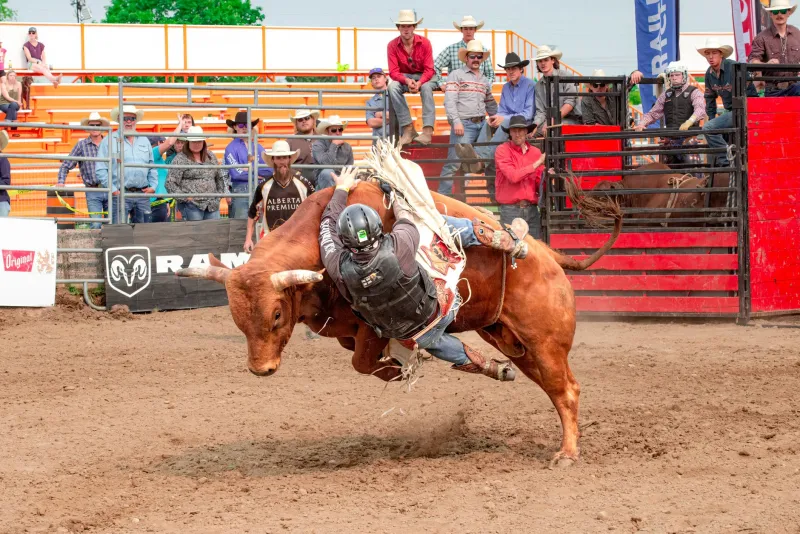
There's a particular kind of calm that descends on a person when a bull is charging and there's nowhere left to run. It isn't bravery exactly — it's closer to clarity. The noise drops away, the crowd disappears, and the only thing that exists is the animal's shoulder, its eye, the angle of its next move. For a teenager named Dale Pruitt growing up outside of Abilene, Texas, that feeling became as familiar as breakfast.
 Photo: Abilene, Texas, via texashistory.unt.edu
What nobody could have predicted — not his parents, not the other clowns who worked the circuit with him, certainly not the rodeo promoters who paid him in cash and handshakes — was that this particular brand of clarity would one day make him one of the most decorated trauma surgeons in the American Southwest.
Born Into the Dust
Pruitt grew up around livestock the way other kids grew up around Little League. His father ran a modest cattle operation, and by the time Dale was twelve, he'd already developed an almost eerie ability to anticipate animal behavior. When a neighbor introduced him to the world of junior rodeo, something clicked. Not in the saddle — he was a mediocre rider at best — but in the arena, running interference, protecting fallen competitors from the animals still in motion.
He became a rodeo clown not because it was glamorous (it isn't) but because he was genuinely good at it. By sixteen, he was working regional circuits across West Texas and southeastern New Mexico, earning a reputation for fearlessness that bordered on recklessness. The veterans on the circuit called it something else: they called it reading.
"Dale could read a bull like a sentence," one former colleague recalled years later. "He knew before the animal knew what it was going to do next."
The Anatomy of Survival
What made Pruitt unusual, even among clowns, was what he did between events. While others played cards or slept in their trucks, he read. Not fiction, not the sports page — anatomy textbooks, borrowed from a local community college library that had never once seen him enrolled as a student.
The interest started practically enough. Working rodeos meant watching injuries up close — broken collarbones, crushed ribs, the particular way a man's body moved when something structural had given way. Pruitt wanted to understand what he was seeing. He started sketching diagrams in a notebook he kept in his gear bag, cross-referencing what he observed in the arena with what he found in the books.
By the time he was nineteen, he had taught himself the basics of human musculoskeletal anatomy with a thoroughness that would have impressed most pre-med students. He just didn't know yet what to do with it.
The Pivot Nobody Saw Coming
The decision to pursue medicine came, as so many decisions do, from a single night that changed everything. During a regional event in Odessa, a young rider took a hoof to the chest and went down hard. Pruitt reached him first, as he always did, and in the thirty seconds before the medics arrived, he made an instinctive call — repositioning the rider's airway, stabilizing his neck — that the attending paramedic later said had almost certainly saved the boy's life.
The paramedic asked him where he'd learned that. Pruitt held up the notebook.
He enrolled in community college the following semester. He was twenty-one years old, working nights at a feed supply warehouse to cover tuition, still doing occasional rodeo weekends to stay liquid. His academic record was, by any conventional measure, unpromising. He'd finished high school with a C average and hadn't thought seriously about college until that night in Odessa.
But something had shifted. The same focus that let him read a charging bull — the ability to process multiple inputs simultaneously, to suppress panic, to commit to a decision in a fraction of a second — turned out to be extraordinarily useful in a classroom. Particularly in courses that rewarded pattern recognition over rote memorization.
The Long Road Through Medicine
Pruitt's path through medical school was neither smooth nor fast. He was rejected twice before gaining admission to Texas Tech's School of Medicine in his late twenties, an age when many of his peers were already completing residencies. He was older, quieter, and conspicuously different from the students who'd been groomed for medicine since high school.
 Photo: Texas Tech's School of Medicine, via www.texasalmanac.com
His instructors noticed something, though. In simulation exercises that required rapid triage decisions — the kind of high-pressure, information-dense scenarios designed to separate the steady from the shaky — Pruitt was almost unnervingly composed. He described his process simply: "I just read the room the same way I read the arena."
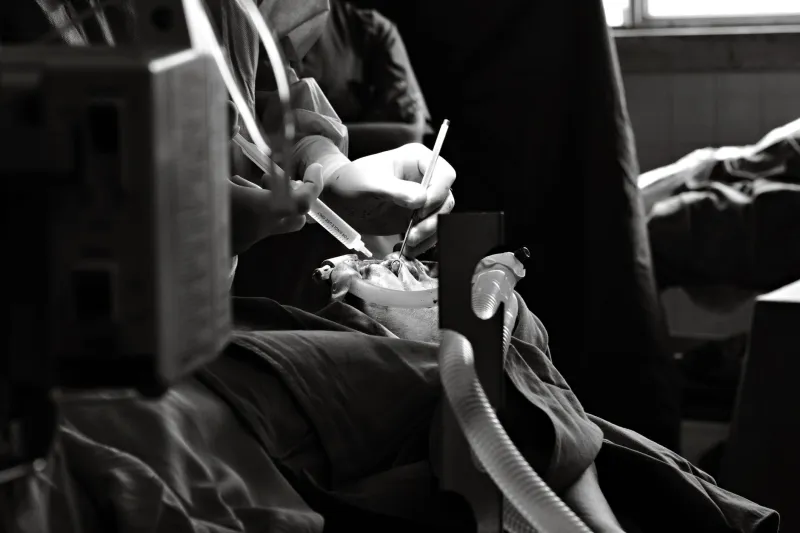
He chose trauma surgery not despite its chaos but because of it. The specialty suited him the way the rodeo circuit had — it demanded presence, speed, and the ability to make irreversible decisions with incomplete information. He completed his residency at a Level I trauma center in El Paso and never really left the region.
A Record Built in Silence
Over the next two decades, Pruitt accumulated a record that his colleagues describe in almost reverent terms. His complication rates in emergency thoracic procedures rank among the lowest in the Southwest. He has trained dozens of residents who now practice across the country, many of whom cite his almost philosophical approach to decision-making as the most valuable thing they learned.
He doesn't advertise his rodeo past. It tends to come out sideways, in the middle of a teaching session, when he's trying to explain to a young resident why stillness under pressure is a skill and not a personality trait.
"You practice it," he tells them. "You practice it in places nobody thinks are classrooms."
That's the part the diplomas on his wall don't capture — the thousands of hours in the dirt, in the noise, in the dust of arenas that no medical school would ever count as training. The credential that matters most in Dale Pruitt's story has no frame around it. It's the instinct he built in a world that had nothing to do with medicine, in service of a future nobody could have scripted.
Every legend started somewhere unexpected. His started at the end of a bull rope.