Stars in His Spare Time: The University Custodian Who Swept His Way to Astronomical Fame
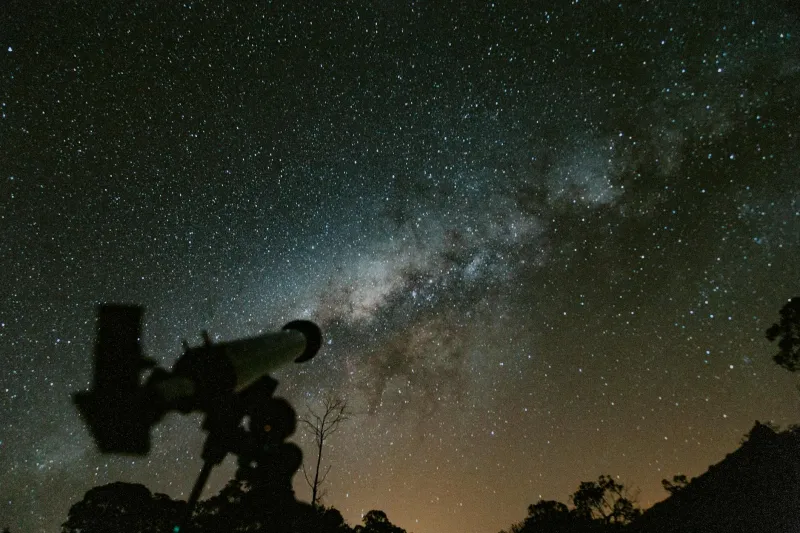
The Graveyard Shift at Palomar
Marcus Williams clocked in at 11 PM sharp, just as the last graduate student shuffled out of the Palomar Observatory complex. While most of San Diego County settled into sleep, Williams began his nightly routine: emptying wastebaskets filled with crumpled calculations, wiping down computer screens still warm from the day's research, and mopping floors that had hosted some of the brightest minds in astronomy.
But Williams wasn't just any custodian. During his fifteen-minute breaks, while the building hummed with the quiet machinery of telescopes tracking distant galaxies, he'd slip into the library and crack open textbooks that professors had discarded or students had abandoned.
"Celestial Mechanics," "Introduction to Astrophysics," "Star Charts of the Northern Hemisphere" — Williams devoured them all. He taught himself to read star maps by the dim light of his cleaning cart, memorizing constellations between bathroom breaks and trash runs.
Learning by Moonlight
What started as casual curiosity grew into something approaching obsession. Williams began arriving early for his shifts, spending his own time in the observatory's public viewing areas. He learned to operate the smaller telescopes, initially just to satisfy his growing fascination with what lay beyond Earth's atmosphere.
The irony wasn't lost on him. During the day, PhD students and postdoctoral researchers used million-dollar equipment to peer into space. At night, the man who cleaned up after them was teaching himself the same science, one discarded textbook at a time.
Williams had dropped out of high school at seventeen to support his family after his father's injury at a construction site. College was never in the cards — he needed steady work, not student loans. The custodial job at the observatory paid better than most, and the night shift meant he could pick up his daughter from school each afternoon.
The Night Everything Changed
It was March 15, 2019, during what should have been a routine cleaning shift. Williams was taking his break in the observation deck, using one of the smaller telescopes to examine the Orion Nebula — a sight that never got old, no matter how many times he'd seen it.
That's when he noticed something that didn't belong.
A fuzzy, moving object in the constellation Lyra caught his attention. Williams had memorized that section of sky over countless nights. He knew every star, every deep-space object visible through the telescope. This was something new.
His hands shook slightly as he adjusted the focus. The object had a distinctive tail — the telltale sign of a comet. But according to everything Williams had taught himself, no known comets were supposed to be visible in that region at that time.
The Discovery That Almost Wasn't
Williams spent the rest of his shift documenting what he'd seen. He sketched the object's position, noted the time, and even managed to take a few photographs with his phone pressed against the telescope's eyepiece — a technique he'd learned from YouTube videos.
But then came the hard part: getting anyone to take him seriously.
When Williams approached Dr. Sarah Chen, the observatory's director, the next evening, her initial reaction was polite but dismissive. A custodian claiming to have discovered a comet? It seemed unlikely, especially when the object would have been visible to the professional astronomers who used the facility's main instruments.
What Williams didn't know was that the main telescope had been undergoing maintenance that week, and the section of sky he'd been observing was in a "dead zone" that the automated sky surveys had temporarily overlooked.
Validation Under the Night Sky
Dr. Chen agreed to look at Williams' photographs, more out of courtesy than genuine expectation. But the images, crude as they were, showed something that made her pause. The object's movement and appearance were consistent with a comet — and one that wasn't in any catalog she knew.
Within 48 hours, Chen had confirmed Williams' discovery using the observatory's main telescope. The fuzzy object was indeed a previously unknown comet, likely originating from the Kuiper Belt and making its first recorded approach to the inner solar system.
The International Astronomical Union, which officially names celestial objects, designated it Comet 2019 F1 (Williams) — making Marcus Williams one of the few people without formal astronomical training to have a comet bear his name.
Beyond the Night Shift
Williams' discovery made headlines, but he kept his day job — or rather, his night job. He still clocks in at 11 PM, still empties those wastebaskets and mops those floors. But now he also serves as a part-time guide for the observatory's public programs, sharing his story with visitors who are amazed to meet the custodian who found a comet.
NASA invited Williams to their Jet Propulsion Laboratory, where engineers explained how they were tracking "his" comet as it continued its journey through the solar system. The boy who never finished high school stood in mission control, watching as some of the world's most sophisticated equipment monitored an object he'd spotted during a coffee break.
The View from Here
Williams' story challenges our assumptions about who gets to participate in scientific discovery. While universities debate diversity in STEM fields and worry about public engagement with science, a night janitor proved that curiosity and determination can be more powerful than credentials.
Today, Comet 2019 F1 (Williams) continues its orbit, visible through telescopes for several more months before it disappears into the outer reaches of the solar system. It won't return for another 75 years — long after Williams retires from his custodial duties.
But somewhere in the Palomar Observatory, probably during a quiet break between cleaning tasks, Marcus Williams will be looking up at the night sky, knowing that among all those points of light, one of them bears his name.