One Bus Ticket, One Guitar, Seven Hometowns That Would Never Be the Same
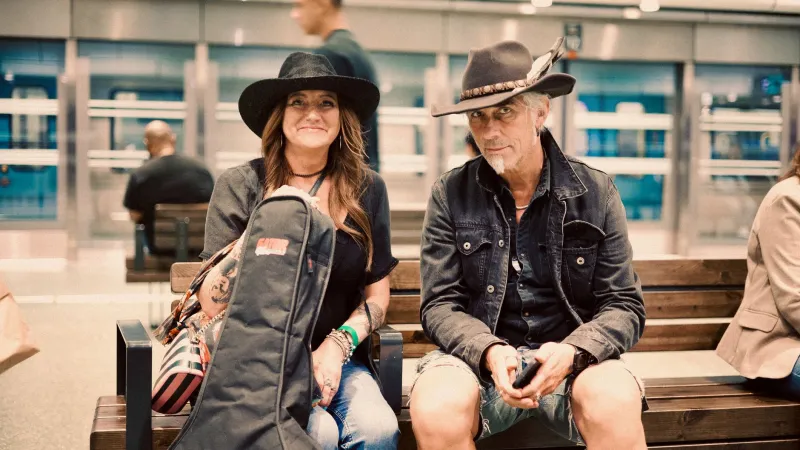
There's a particular kind of courage that only people from struggling places understand. It's not the dramatic, movie-poster kind. It's quieter — the courage to board a Greyhound with a guitar case that costs more than everything else you own combined, heading somewhere you've never been, betting on a talent that nobody around you has ever fully believed in.
These seven artists made that bet. And when it paid off, they came home.
The Steel Town Soprano
Braddock, Pennsylvania doesn't appear on many tourist maps. In the 1980s, when the mills started going dark, it became the kind of place people measured their futures by how fast they could leave. Denise Carver was seventeen when she packed a secondhand suitcase and caught a bus to Pittsburgh, then another to Nashville, with $200 sewn into the lining of her jacket and a voice her high school choir director had called "uncomfortably large for a room this size."
She spent three years sleeping on couches, waitressing double shifts, and singing backup for artists whose names you'd recognize. Her debut album, recorded in a borrowed studio on a Tuesday night, earned her two Grammy nominations and a profile in Rolling Stone that described her sound as "Appalachian gospel filtered through industrial grief."
She described it as just sounding like home.
When Braddock's last community center shuttered in 2009, Carver bought the building outright. Today it operates as a free music conservatory for kids whose zip code had previously made them invisible to the arts establishment. The waiting list runs two years long.
The Swamp Guitarist Nobody Recruited
Moss Bluff, Louisiana is the kind of community that doesn't show up in music industry scouting reports. Marcus Thibodaux grew up there, learning slide guitar from his grandfather on a porch that had been flooding every spring for forty years. He was twenty-two when he drove a borrowed truck to New Orleans, slept in it for six weeks, and eventually talked his way into a residency at a Frenchmen Street club that normally didn't book anyone without a following.
He built the following from scratch.
By the time his third album went gold, music journalists had coined the phrase "bayou minimalism" to describe what he did with six strings and a glass bottleneck. Thibodaux never loved the label. What he loved was the fact that he could now fund the levee restoration project in Moss Bluff that FEMA had been promising since 2005. He partnered with a civil engineering nonprofit, donated the majority of his advance from his fourth record, and showed up personally for the groundbreaking in rubber boots.
"The music got me out," he told a reporter that day. "But the place is what made the music."
The Choir Kid from the Rust Belt
Youngstown, Ohio has a complicated relationship with its own mythology. It was once a city of furnaces and futures; then it became a cautionary tale. Aaliyah Simmons was born into the cautionary tale chapter. Her mother worked two jobs. Her father was mostly absent. The one constant in her childhood was the choir at her grandmother's church, where she sang every Sunday with the kind of conviction that made the congregation go quiet in a different way than usual.
She left at nineteen with a scholarship to a music program in Atlanta that covered tuition but not living expenses. She made up the difference by performing at weddings, funerals, and eventually corporate events that paid surprisingly well. Her vocal range attracted a producer who'd worked with three of the previous decade's biggest R&B acts. Her debut single spent eleven weeks on the Billboard charts.
The Grammy came four years later. So did the foundation she established in Youngstown — a mentorship program pairing working musicians with kids from underserved schools. She funds it entirely herself and chairs the board from wherever she happens to be on tour.
The Country Singer Who Came From Nowhere, Literally
Clarence, Texas has a population that hovers around 300, depending on the year and who's counting. When Jake Pruitt told people he was moving to Austin to pursue country music, most of them assumed he'd be back within a season. He wasn't.
Pruitt's path to a recording contract was less a straight line than a series of stubborn detours — open mics, regional radio spots, a YouTube video that accumulated two million views before he'd ever played a venue with assigned seating. His songs had the specific texture of flat, dry, wide-open spaces, the kind of loneliness that isn't sad so much as honest.
His second album debuted at number three on the country charts. His third won him a Grammy for Best Country Album.
Clarence, Texas now has a community arts center named after his late grandmother, funded by a percentage of every album sold. The town also hosts an annual songwriting festival that has quietly become one of the best-kept secrets on the Americana circuit. Pruitt curates the lineup personally, with a standing policy that at least half the performers have to come from towns you've never heard of.
The Jazz Pianist From the Forgotten Neighborhood
In Detroit's North End, during the early 1990s, the conversation wasn't about jazz. It was about survival — which schools were still open, which blocks were safe after dark, which families were making it and which weren't. Elaine Okafor was making it, barely, by playing piano at her aunt's restaurant for tips and learning theory from library books because lessons weren't in the budget.
She got to Berklee on a partial scholarship and a lot of borrowed money. She graduated, moved to New York, and spent a decade building a reputation in jazz circles that valued precision and emotional intelligence in equal measure. When her debut record landed on the cover of JazzTimes, the profile noted that she played "as if she had something specific to prove to a specific place."
She did. She returned to Detroit and co-founded a jazz education program in her old neighborhood, now operating out of a renovated warehouse that once sat derelict for fifteen years. The program has produced four Berklee scholarship recipients in the last six years.
The Folk Singer Who Mapped Her Town in Songs
Harlan County, Kentucky carries the weight of a hundred years of coal and conflict. Maggie Combs grew up there knowing both. Her father worked the mines; her mother kept the books for the local union. Maggie learned to play banjo at twelve and started writing songs at thirteen that were, even then, less like folk music and more like journalism set to melody.
She left for Asheville at twenty, then eventually New York. The music industry didn't quite know what to do with her — too country for folk, too political for country, too literary for radio. She found her audience anyway, slowly and then all at once, the way these things tend to happen. Two Grammy nominations. A MacArthur Fellowship. A New Yorker profile that described her as "the closest thing American music has to a documentarian."
Combs used the MacArthur money to commission an oral history project in Harlan County, employing local writers and recording equipment to preserve stories that had never been written down. The archive is now housed at the University of Kentucky and accessible to the public for free.
The Hip-Hop Producer Who Rebuilt the Block
Compton, California has been narrated by outsiders for thirty years. Darius Webb grew up there and understood early that the gap between how his neighborhood was described and how it actually felt to live there was enormous. He started producing beats at fifteen on a secondhand laptop. By twenty-five, he'd produced tracks for four platinum-selling artists without most people knowing his name.
His own album, released when he was twenty-eight, changed that. It was the kind of record that music critics struggle to categorize and listeners play on repeat — layered, specific, and unmistakably rooted in a place. It won him a Grammy for Best Rap Album and launched a conversation about Compton that, for once, he felt was being told correctly.
He moved back the following year. His production studio, built on a lot that had been vacant for two decades, operates on a sliding-scale model — established artists pay full rate, emerging local artists pay what they can. He's also partnered with the city on a youth employment program that has placed over 200 kids in music industry internships since 2018.
What the Bus Ticket Actually Cost
Seven people. Seven places that the music industry wasn't looking. Seven stories that don't follow the standard template of discovery and departure — because these ones have a third act that most success narratives skip.
The return.
It's easy to celebrate artists who make it. It's rarer, and more interesting, to celebrate the ones who make it and then turn around and pour something back into the soil that grew them. These seven didn't treat their hometowns as origin stories to be outgrown. They treated them as unfinished business.
That's a different kind of success. And it turns out, it's the kind that lasts.