When Bullets Couldn't Stop the Brush: The One-Armed Veteran Who Painted His Way to Glory
The sniper's bullet found Horace Pippin in the Argonne Forest in 1918, tearing through his right shoulder and leaving his dominant arm partially paralyzed. For most men, that might have been the end of any artistic dreams. For Pippin, it was just the beginning of one of the most unlikely art careers in American history.
The Gravedigger's Canvas
Back home in West Chester, Pennsylvania, Pippin returned to the only work his damaged body could handle—digging graves and doing odd jobs around town. But something had changed during those brutal months in France. The images wouldn't leave him alone: the trenches, the faces of fallen comrades, the way fire looked against a winter sky.
With no money for proper art supplies and an arm that could barely hold a pencil, Pippin got creative. He heated a poker in the fire and began burning designs into scraps of wood. The process was slow, painful, and required him to support his weak right hand with his left. Each line had to be deliberate—there were no second chances with hot metal on wood.
"I paint it exactly the way it was," he would later say about his war memories. "I don't add nothing or take nothing away."
Teaching Himself in Secret
For nearly two decades, Pippin worked in complete isolation. He had no formal training, no art teachers, no community of fellow artists. What he had was an obsession with getting the images out of his head and onto whatever surface he could find.
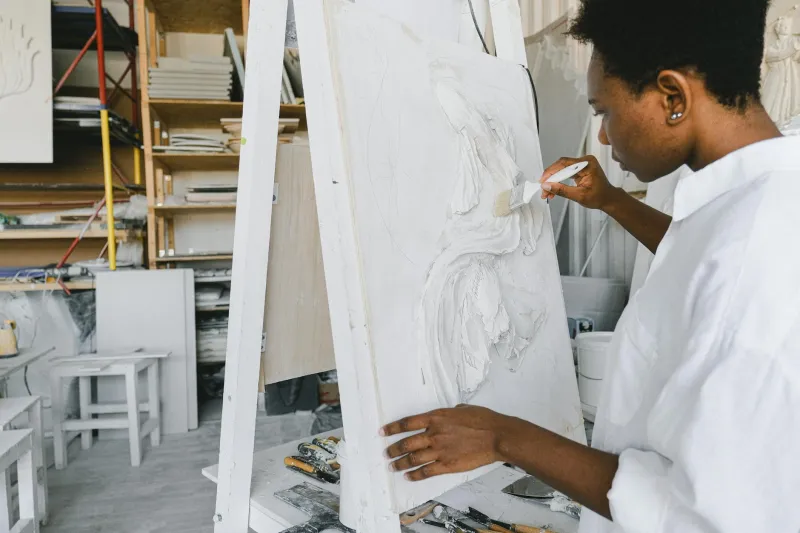
Gradually, he moved from wood burning to painting, mixing his own colors and stretching his own canvases. His wife Jennie thought he was wasting money they didn't have on tubes of paint. Neighbors saw him as the quiet Black veteran who painted pictures in his spare time—nothing more.
But Pippin was developing something remarkable: a raw, emotional style that captured American life with unflinching honesty. His paintings depicted everything from Civil War battles he'd never witnessed to quiet domestic scenes, all rendered with the same intense, almost primitive power.
The Breakthrough That Almost Didn't Happen
In 1937, at age 47, Pippin finally worked up the courage to enter a painting in a local art exhibition. "The End of the War" showed soldiers celebrating armistice, painted in Pippin's distinctive style—bold, dark, and emotionally charged.
A local art critic noticed the painting and wrote a small piece about this unknown Black artist. That tiny review caught the attention of Philadelphia collectors, then New York galleries, and suddenly the art world was beating a path to West Chester to meet the gravedigger's son who painted like nobody they'd ever seen.
Recognition Without Compromise
What amazed critics was Pippin's refusal to change his style for commercial success. While other folk artists often softened their work for mainstream appeal, Pippin kept painting exactly what he saw and felt. His canvases tackled racism, war, poverty, and injustice with a directness that made viewers uncomfortable—and that's exactly how he wanted it.
"My opinion of art is that a man should have love for it, because my idea is that he paints from his heart and mind," Pippin explained. "To me it seems impossible for another to teach one of art."
By the 1940s, Pippin's work was hanging in major museums alongside pieces by established masters. The Museum of Modern Art, the Phillips Collection, and the Barnes Foundation all acquired his paintings. Art critics called him one of the most important American painters of his generation.
The Price of Late Recognition
Pippin's sudden fame came with complications he never expected. Gallery owners wanted to manage his career, critics tried to categorize his work, and collectors competed to own pieces by the "primitive" painter from Pennsylvania.
But success couldn't erase decades of struggle or heal old wounds. Pippin's war experiences continued to haunt his dreams, and his damaged arm caused constant pain. He painted furiously, as if making up for lost time, completing over 140 works in just eight years of recognition.
A Legacy Painted in Truth
When Pippin died suddenly of a stroke in 1946, he left behind a body of work that redefined what American art could be. His paintings weren't pretty or polite—they were honest. They showed an America that many preferred to ignore: the America of segregation, violence, and hardship alongside moments of beauty and hope.
Today, Pippin's paintings sell for hundreds of thousands of dollars, and art historians consider him a crucial figure in 20th-century American art. But perhaps his greatest achievement was proving that artistic genius doesn't require formal training, financial backing, or social connections—sometimes it just requires the stubborn determination to keep painting, one painful brushstroke at a time.
The man who started by burning pictures into wood with a hot poker ended up burning his vision into the American consciousness. Not bad for a gravedigger's son with a bullet-damaged arm and a head full of images that wouldn't let him rest.